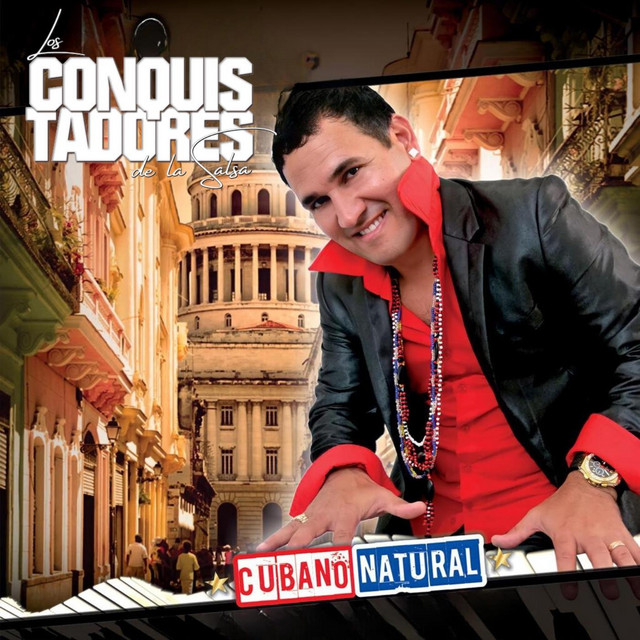
The Cuban pianist Robert Armas formed this orchestra in Havana almost 20 years ago, but left for Peru the following year. where he has lived since.
The Cuban-Peruvian orchestra has long been one of the most respected salsa orchestras in Latin America, and is proud to be the first to bring Cuban timba to Peru. During the recent years, they have been on a salsa conquest touring Europe five times, with several salsa hits across the continent.
Los Conquistadores are closely tied to the story of how Cuban popular music took root and grew in Peru. Formed in 1997, they became known as one of the pioneering groups bringing this sound and band format to Peruvian audiences—at a time when Cuban music was present, but the specific “Latin/Cuban orchestra” concept wasn’t yet established locally in the same way.

-
 4:11Choque y FugaLos Conquistadores de la Salsa
 -
4:30Despojate Con ElegguaLos Conquistadores de la Salsa
-
4:48La EnvidiaLos Conquistadores de la Salsa
-
4:51Mal PasoLos Conquistadores de la Salsa
-
4:43A Quiu00e9n No Le Gusta CubaLos Conquistadores de la Salsa
-
4:01DijeLos Conquistadores de la Salsa, Alvaro Rod
-
4:26La MarimbaLos Conquistadores de la Salsa
-
4:12Un DJ y un SoneroLos Conquistadores de la Salsa
-
3:42A Mi Me Gusta el SonLos Conquistadores de la Salsa
-
3:55Asu00ed Nadie Te Va a QuererLos Conquistadores de la Salsa
-
4:04Calma - Versiu00f3n salsaLos Conquistadores de la Salsa
-
4:14Me Niego - Versiu00f3n SalsaLos Conquistadores de la Salsa


What makes the group especially interesting is how intentionally they’ve worked with cultural exchange rather than just “exporting” a style. Over time, the orchestra developed into a mix of Cuban and Peruvian musicians, and a big part of their identity has been helping local players truly own the genre. That doesn’t happen automatically: it takes training, rehearsal culture, and an understanding of what gives Cuban music its character—how the rhythm section locks in, how the phrasing sits, and how the whole band breathes together.
The band has described how the early years could be challenging precisely because this music is so tied to Cuban tradition. Their response was to do the hard, practical work: workshops, classes, and hands-on coaching, so the musicians around them could internalize the concept rather than simply imitate it. The result is a group that doesn’t feel like a “copy” of Cuban music—it feels like a living, local scene that has learned the language properly.
They’ve also shown a clear respect for the broader Cuban musical heritage, not only the modern dancefloor energy. Along the way they’ve aimed to keep classic Cuban genres present—things like son and cha-cha-cha—styles that are foundational to Cuban identity and that still matter globally, especially in dance communities.






Why Los Conquistadores and rueda.casino fit together
rueda.casino is all about dancers connecting more deeply with the music—timing, structure, phrasing, and cultural context—so training becomes more than memorizing figures. That overlaps naturally with Los Conquistadores’ view of how Cuban music survives and spreads: it needs to be used, shared, and actively brought into new spaces.
From their perspective, letting other communities work with the music is not “giving something away”—it’s part of how the orchestra and the genre get more widely known. They’ve spoken positively about people using their music as a way of promoting the band and helping the sound travel further, and they’ve supported the idea that you need many different channels for the music to be truly diffused.
That’s why the collaboration with rueda.casino makes sense: dancers get access to authentic Cuban-inspired orchestra music to train with, and the band’s sound gets carried into a global learning environment where people are actively listening, repeating, and building skill on top of the rhythms. It’s a win-win that strengthens the link between live band culture and the international rueda community—exactly where Cuban music tends to thrive the most.
In 2018 we were able to do an interview with the band leader Robert Armas. Here is that interview.


