Jorge Luna is a Cuban rueda de casino instructor and choreographer who has spent nearly four decades spreading this joyful dance form and pushing its creative boundaries. Based in Santiago de Cuba, Luna has been instrumental in evolving rueda de casino from local social circles to international stages, all while maintaining the dance’s authentic Cuban spirit. He is best known as the founder and director of the renowned Compañía All Stars troupe, through which he has introduced innovative choreography and inspired new generations of dancers. With an informal, passionate teaching style and an unwavering respect for tradition, Jorge Luna’s story is intertwined with the modern history of Cuban salsa and rueda culture.
Early Life and Dance Beginnings
Luna’s journey into dance started in the mid-1980s in his hometown of Santiago de Cuba. In his early 20s he was working as a DJ (or musicalizador) at a local school, where he would play music for student dance activities. Watching the students dance casino (the partner dance that rueda is based on) fascinated him – “the interaction they had, the joy they showed” immediately caught his attention. Intrigued, he convinced one of the dancers to teach him the basics of casino. Despite an initial rebuff (“No, no… stick to the music” the friend said), Luna persisted and quickly picked up the steps. By age 20, he was not only dancing casino but already brimming with ideas to shake it up.
His first big break came during a school gala artística (talent show) where he and friends organized a rueda performance.
Background
Contribution to Rueda de Casino
Jorge Luna’s contributions to the Rueda de Casino community span nearly four decades and are marked by fearless innovation and deep respect for tradition. As founder of Compañía All Stars, he has pioneered new rueda formations, redefined performance standards, and helped legitimize the dance on national stages in Cuba. Luna’s work has inspired local rueda scenes across eastern Cuba and made waves internationally through workshops, competitions, and groundbreaking performances. His choreography blends creativity and Cuban identity, making him one of the key figures in rueda’s evolution.
Further Reading and Resources
For more on Jorge’s classes, performances and projects, follow his updates on social media and watch Jorges contribution to rueda.casino to see him in action and learn.
Luna’s creativity emerged early – he dared to break some of the unwritten rules of casino by incorporating two concentric circles and even splitting the rueda into lines and cross formations. “I broke a bit the norms of casino of that time,” he recalls of that debut, which ended up bringing down the house. The audience response was “apotheosis,” and the success convinced his peers to let Luna lead as a caller (leader) in future ruedas. From that moment, he was hooked. As the interviewer in a recent talk quipped, he never let go of the rueda after that – and Luna affirmed, “Nunca la solté,” he never let it go.
By the late 1980s, Luna was choreographing ever larger and more ambitious ruedas. In one local high school rivalry, he started with a 15-couple wheel that swelled into a 30-couple spectacle, and ultimately 40 couples joined in for a final show. “That was crazy,” he said of the feat, which featured dramatic entrances and exits and wowed a packed theater. Notably, Luna was doing all this as an unpaid enthusiast – “I was basically doing it for love,” he admits of those early years. These grassroots beginnings – DJ by day, self-taught dancer by night – laid the foundation for Jorge Luna’s unique blend of musicality, creativity, and community-driven passion.
Innovating Rueda: Style and Contributions

Rueda de Casino group class with Jorge Luna Roque — building timing, connection, and flow in Cuban salsa.
From the start, Luna demonstrated a flair for innovation in rueda de casino. He wasn’t afraid to experiment with formations and patterns that were unheard of in the conservative rueda scene of the 1980s and 90s. For example, he pioneered the idea of multiple circles and breaking the wheel into new shapes at a time when most ruedas stayed in a single closed circle. This nonconformist streak would become a hallmark of his choreographic style. “I never changed that methodology… I’m not going to change it; I’ll keep creating on that,” Luna says about sticking to his creative approach even when others doubted it.
One of Luna’s early signature innovations was to “desintegrate” the rueda circle mid-dance – having couples peel off into lines or other configurations – and then seamlessly reform the circle. This daring move got his first official team (cheekily named La Máquina del Sabor or “The Flavor Machine”) disqualified at a major Santiago de Cuba rueda competition in 2003. Judges at the time insisted a rueda “should not be broken” and wanted strict circles. The teenage dancers in Luna’s group were so upset that they sat down on stage in protest, an act that led organizers to ban the team for “indiscipline”. Rather than be discouraged, Luna treated it as a learning experience . He told his dancers that one day their style would gain acceptance, and indeed he was right. He refused to tone down his creativity, and only a short time later the same choreography that had been rejected earned a standing ovation – and a perfect score – on national TV.
In late 2003, following that early setback, Jorge Luna regrouped and founded a new troupe with a bold vision. Initially they called themselves “La Máquina del Sabor,” but by January 2004 Luna decided to rename the group All Stars – symbolizing that they were aiming for something big. “We’re going to do something big, and if we’re going to do it, we have to make sacrifices,” he told the young members as they embarked on intensive practices. Compañía All Stars went on to become Santiago de Cuba’s premier rueda de casino team, known for intricate, high-energy rueda performances. They made history on Cuban television by becoming the only rueda team to ever score a perfect 50 points on the wildly popular show Para Bailar Casino (the Cuban casino dance competition show). Over three seasons of that show, more than 300 rueda groups competed, but only All Stars achieved the maximum score – a testament to Luna’s choreographic genius.
Luna’s choreographies are often described as both innovative and true to tradition. He has a knack for weaving classic casino elements with fresh, theatrical ideas. Dancers who have trained with him describe him as “nothing short of a Casino genius” who developed a “unique, intricate, dynamic style that is as challenging as it is fun”. For example, Luna might incorporate modern music breaks or playful themes into a rueda, but he is careful to keep the core of Cuban casino visible. One famous All Stars routine involved blindfolding the male dancers and letting the female dancers lead – flipping the usual lead-follow dynamic. “I said, let’s have the girl guide you. Don’t use force,” Luna explains of this experiment, which required the women to navigate the entire wheel and even correct any mistakes by the men. The result was a hit, showcasing how capable and important the follow role can be in a rueda when given the opportunity. In another celebrated innovation, Luna once found himself with only half the usual number of male dancers at a rehearsal – so he paired each man with two women and created a rueda with dos mujeres por hombre. This “double partner” rueda routine (performed to Los Van Van’s song “Si a una mamita”) “brought the house down” in Havana and later went viral as one of the most-watched rueda videos online. Time and again, Luna has demonstrated a fearless creativity, introducing moves and concepts that initially surprise audiences and judges, but eventually expand the vocabulary of rueda de casino.
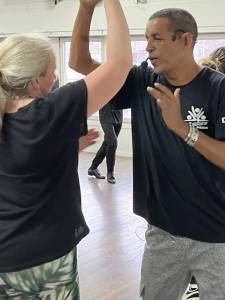
Jorge Luna Roque demonstrating partner technique in Casino / Rueda de Casino during a class.
Beyond eye-catching moves, Jorge Luna has also contributed immensely to the community and pedagogy of rueda. In Cuba, he spent years traveling to different provinces like Holguín, Bayamo, Las Tunas and Guantánamo to help organize local rueda events and contests. He would approach regional culture directors with offers to support rueda de casino workshops, provide choreographic ideas, and share his experience. Importantly, Luna never wanted to create carbon copies of his own team; instead, he encouraged each locale to develop its own style. “I didn’t want people to do the same as me; each should have their own style of dance,” he says, noting that he was happy to “support with organization, ideas, workshops” so long as dancers “believe in what is theirs”. This philosophy helped spark a thriving rueda scene across eastern Cuba, with many communities forming teams inspired (but not dominated) by Luna’s approach. His stature grew such that he was often invited to serve as a judge at casino dance competitions around Cuba. Ever the gentleman, Luna as a judge is known for his supportive feedback – he avoids harsh criticism because “the easiest thing is to criticize, but nobody knows the sacrifice each person makes for their work”. This empathy comes from his own journey and struggles pushing casino forward. By mentoring others and legitimizing rueda de casino as an art form on par with more formal dances, Luna has helped ensure that Cuban casino dancing not only survives but thrives with variety and vitality.
Global Impact: Bringing Cuban Rueda to the World
In the past decade and a half, Jorge Luna has taken his passion beyond Cuba’s borders, becoming a globe-trotting ambassador of rueda de casino. After honing the All Stars troupe in Cuba throughout the 2000s, he began receiving invitations abroad as Cuban salsa’s popularity surged worldwide. His first international trip came in the late 2000s – “I traveled the first time in 2008,” he notes, accompanying a fellow Cuban instructor to an overseas event. The true international break for All Stars, however, arrived in 2014 when Luna and his dancers were invited to perform and teach in Europe and the Americas. “From 2014 and 2015 onward we made a series of trips to the United States, Mexico, Argentina, Colombia…” Luna recounts, thrilled that “everywhere we went, it was great”. Audiences and students abroad were captivated by the high-energy, authentic Cuban style that he brought.
In 2016, the All Stars made their West Coast U.S. debut, thanks to a three-week residency organized by dance promoters in California. Luna’s 11-member company performed full-length shows at theaters in San Francisco and conducted workshops across the Bay Area. They even joined forces with local salsa groups to perform at the famous San Francisco Carnaval parade. This tour was a huge success, building bridges between Cuban dancers and the international salsa community. It also demonstrated Luna’s ability to connect with dancers regardless of language barriers – his enthusiasm and the universal language of dance carry the message. Since then, Jorge Luna has been a sought-after instructor at salsa and rueda festivals across Europe, from Norway to France to the UK. He has taught at the annual SalsaNor Rueda Congress in Scandinavia (one of the largest rueda-focused events) and led organized dance trips for foreigners to study casino in Cuba. His influence is truly global: wherever there is interest in Cuban salsa, Luna finds a welcoming community eager to learn “al estilo Santiago.”
One of the most dramatic examples of Luna’s global impact came in 2024, when Havana hosted a historic rueda de casino world record attempt. Luna was one of the key figures organizing and “leading the charge” for this event, alongside other Cuban dance luminaries. The goal was to gather the largest number of people ever dancing rueda de casino simultaneously. Thanks to months of nationwide workshops and community rehearsals – including efforts in Santiago de Cuba and other cities – the May 2024 event drew an astonishing 2,946 dancers, forming 142 ruedas on Havana’s Malecón. This set a new Guinness World Record and underscored Cuba’s pride in its dance heritage. For Jorge Luna, helping unite so many dancers was a profoundly moving experience. He has long advocated that rueda de casino “gives people health… joy… and socialization” through its sense of community. Seeing thousands dance together in Havana, with international observers cheering on, reinforced that belief. It was the perfect embodiment of Luna’s mission to “make people love the rueda” – not just because it’s Cuban, but because of the happiness and togetherness it creates.
Today, Jorge Luna continues to travel, teach, and perform. Whether it’s an advanced workshop in Mexico

A massive Rueda de Casino world record attempt in Havana (May 2024), where Jorge Luna helped lead nearly 3,000 dancers in unison.
City or a beginner lesson in a small European town, he brings the same infectious energy and warmth. Dancers often comment on how approachable he is for someone of his stature. He’ll just as eagerly lead a casual social dance in a park as he will direct a polished stage performance. In all cases, he serves as a living link between Cuban dance traditions and the worldwide salsa community. Luna’s global influence is also evident online – videos of his choreographies rack up views on YouTube, and his social media is followed by aficionados from dozens of countries. Through these international engagements, Jorge Luna has helped standardize certain rueda concepts globally (people everywhere now dance some of the figures popularized by All Stars) while also celebrating the rich local flavors that different communities bring to the dance.
Teaching Philosophy: Unity in Diversity

Jorge Luna Roque filming a Rueda de Casino lesson for rueda.casino.
Despite his celebrity as a choreographer, Jorge Luna remains first and foremost a teacher and guía. His teaching philosophy centers on inclusivity, creativity, and respect for each dancer’s individual style. “I look for social dancers. I don’t care whether they dance well or not,” he says, “As long as you can walk, that is enough for me.” This quote encapsulates Luna’s belief that anyone can be taught and molded into a great dancer with the right passion and guidance. In fact, many of the All Stars members over the years started as raw students who simply loved to dance; under Luna’s mentorship they blossomed into polished performers. He actually prefers working with enthusiastic amateurs rather than trying to retrain professional dancers with fixed habits. The result is a team and a teaching style that have a very down-to-earth, family vibe – everyone is there out of love for the dance, not ego.
A key aspect of Luna’s approach is getting to know his dancers as people. “Firstly, you should know your members, because each person will contribute something,” he advises new instructors. He observes each dancer’s personality and strengths, and then builds a group identity that lets those qualities shine. “Each person has a different character… when you meld them, you create a group identity,” Luna explains. In the All Stars, for example, he fostered a playful, upbeat atmosphere because he wanted the dancers to be as joyful as the music. “I choreograph in a happy way, because I try to get the kids to be joyful,” he says of his style. This emphasis on fun is not just for show – Luna believes an upbeat, encouraging environment actually pushes dancers to new heights. “The students create challenges for you,” he notes – once they master one move, he feels compelled to invent something harder, continually raising the bar. In this way, teacher and students inspire each other. “We all learn, because sometimes the teacher learns more when facing the students… I always say you end up learning more than what you give,” Luna reflects, crediting the passion of his students for making him a better instructor.
Standard Moves vs. Local Flavor
One interesting challenge Luna often discusses is the balance between standardizing rueda moves and embracing local variations. As rueda de casino spread across Cuba and now globally, different regions and groups developed their own calls and stylistic tweaks. Luna likens these to distinct “dialects” of the dance – all rooted in the same traditional figures, but each with a unique code. For instance, the classic move Setenta (“70”) exists everywhere, but some groups execute or even call it slightly differently. Back in the early days of rueda, there was a fixed set of traditional moves everyone knew. “When rueda started there were specific traditional figures everyone did to start,” Luna notes. But as talented leaders around Cuba created new variations, they often reused the old names in creative ways or changed the names entirely – and thus each rueda team began to form its own repertoire.
Luna does not see this diversity as a bad thing at all. In fact, he views it as the natural “creation” process in action. “All figures came from the ones before,” he says – today’s fancy moves are built on yesterday’s basics. He encourages each leader to have their own sello (stamp) on rueda. The only downside is that a dancer from Santiago might not immediately know the calls in, say, Guantánamo, if each community uses unique codes. As Luna puts it, “today, each group dances in its own group; you can’t just jump into another’s” because the calls might not match up. However, when it comes to social dancing, he emphasizes the importance of common ground. When different rueda aficionados meet on the dance floor socially, Luna says everyone should default to the standard, known version of a move. “When everyone comes together, if you call a Setenta, it has to be a Setenta [the usual way]; if you call an Enchufa Doble, it has to be [the standard]…”. In other words, there is a time for improvising with your personal group’s style, and a time for sticking to basics so that any rueda dancer from anywhere can join the fun. Luna’s ability to navigate these nuances has made him a unifier in the rueda world – he appreciates local flavor but also teaches the foundational figures that underpin the dance everywhere.
Preserving Rueda’s Essence and Future
Even as he innovates, Jorge Luna is a vocal advocate for preserving the cultural essence of rueda de casino. He often stresses the importance of remembering where this dance came from and what makes it unique. “Maintain identity, keep what has always been done. Don’t lose the identity and don’t lose its history,” Luna urges, especially now that rueda is spreading worldwide. He has a bit of concern that in the rush to create ever more spectacular routines, some dancers might drift too far from the roots. “Nowadays they call it evolution,” he says, “but it can also carry the danger of ‘involution’, because we think we’re doing new things and perhaps that is affecting the history”. The message is clear: not every wild new idea equals progress; some “innovations” might actually dilute the very character of casino if they ignore its core principles. Luna cites examples of moves that incorporate gymnastics or non-salsa dance elements purely for shock value. He doesn’t condemn creativity – “there are thousands of things that can be done without altering casino,” he insists – but he feels certain additions (like excessive lifts or acrobatics) stray beyond what casino is about. “Sometimes people start doing lifted moves… I don’t know,” he says with a shrug, implying that those might be better suited to another dance context. Rueda de casino, in Luna’s eyes, already has endless beautiful possibilities within its own genre – from elegant son and danzón influences to Afro-Cuban rumba styling – so one need not bolt on unrelated tricks just to seem novel.
Luna has a favorite saying: “Whoever forgets history is condemned to repeat it.” He quotes this to remind young dancers that you have to know and honor the social dance tradition that came before you, even as you add your chapter to it. In practical terms, he encourages instructors and event organizers around the world to set some boundaries to keep rueda de casino recognizable. “It depends on us, on all of us who defend [casino],” he says about the dance’s future. Luna believes if those leading the community – teachers, team captains, festival organizers – hold the line on preserving the fundamentals, rueda will remain strong for generations. For example, he suggests that competitions labeled as “rueda” should actually showcase rueda de casino, not devolve into freestyle showdance. “If you want casino to be maintained, you have to create some parameters,” Luna advises, otherwise you get events where “they say it’s rueda and it’s less rueda than something else.” By upholding standards (without stifling creativity), the community can evolve in a healthy way.
Ultimately, Jorge Luna is optimistic. The global enthusiasm he’s witnessed for Cuban dancing convinces him that rueda de casino will continue to flourish. But he gently puts the onus on each dancer to do their part in honoring the dance’s soul. “It doesn’t depend on reaching 2025 or 2040,” he says of rueda’s survival, “It depends on each person – on what we decide to defend.” If Luna’s own career is any indication, he will certainly be defending and celebrating rueda de casino every step of the way. As long as there is music playing and people willing to form a circle, you can count on Jorge Luna to call “¡Arriba, la rueda!” and ensure this Cuban treasure keeps spinning into the future.


